Your Brain Has a 90-Second Timer: The Psychology Behind Every Countdown Clock You See
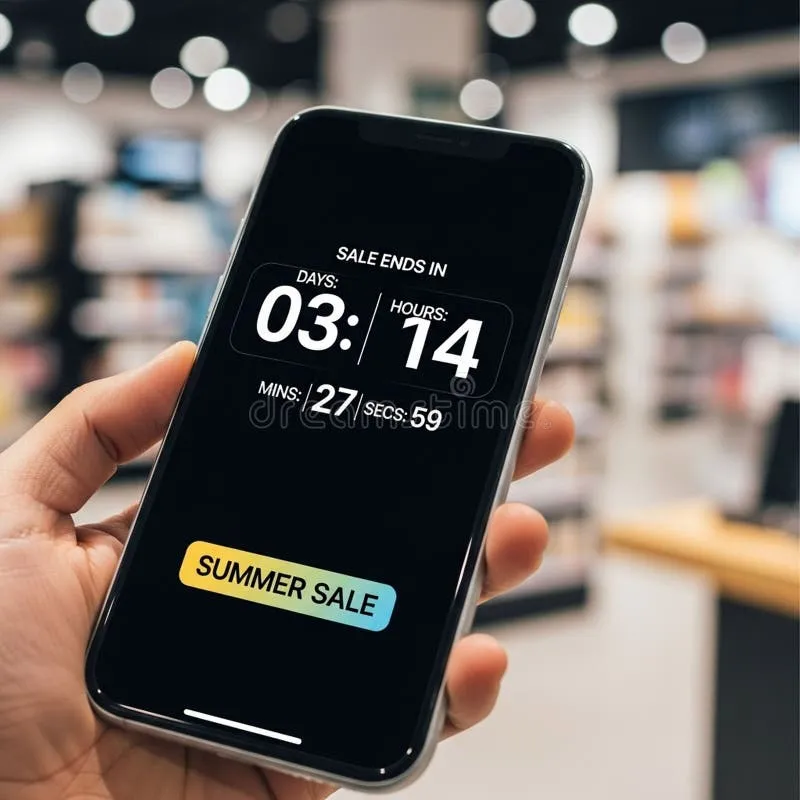
Photo: online shopping countdown timer flash sale smartphone laptop, via thumbs.dreamstime.com
You've felt it before. That little red timer blinking on a Target or Best Buy product page. "Deal ends in 14:59." Your pulse ticks up, your thumb hovers over "Add to Cart," and suddenly a $89 air fryer feels like a once-in-a-lifetime opportunity.
Congratulations — you've just experienced what behavioral scientists call the urgency effect, and it has a shelf life of roughly 90 seconds. That's about how long the average shopper takes to decide whether to buy once a scarcity cue appears. Miss that window, and the spell breaks.
Why Your Brain Falls for a Countdown Clock
The core mechanism is simple: humans place higher value on things that are scarce. Research popularized by psychologist Robert Cialdini identifies scarcity as one of the most reliable levers of persuasion — when something seems limited, we instinctively assume it must be desirable, and we fear missing out more than we crave saving money.
Retailers know this. Amazon's "Only 12 left in stock" notices, Walmart's "Rollback ends today" banners, and the now-ubiquitous countdown timers on everything from Wayfair to Dick's Sporting Goods aren't accidental design choices. They're engineered to compress your decision-making window so your rational brain — the part that asks "do I actually need this?" — never gets a word in.
There's also loss aversion at play. Studies consistently show that people feel the pain of losing roughly twice as strongly as the pleasure of gaining. A flash sale reframes the transaction: instead of "save $40," the message becomes "lose $40 if you don't act now." That subtle shift is why you'll happily buy something at midnight you'd have scrolled past at noon.
When Urgency Is Real — and When It's a Costume
Here's the uncomfortable truth: not every countdown timer is lying, but plenty of them are wearing a costume.
Some urgency is genuine. Clearance events genuinely deplete stock. Holiday sales genuinely end. That 55-inch TV really will go back to full price when the Super Bowl deal window closes.
But plenty of it is theater. Investigations by consumer watchdogs and journalists have caught retailers running "ending tonight" sales that simply reset the next morning. Some sites display fake "X people are viewing this item" counters or countdown clocks that refresh for every visitor. A few fast-fashion giants have been accused of running perpetual "flash sales" where the "sale" price is just the regular price with a strike-through.
The trick is learning to tell the difference before your 90 seconds are up.
The 90-Second Reality Check
Before you tap "buy," run through this quick checklist. It takes less time than the timer on your screen:
- Check the price history. Tools like CamelCamelCamel (for Amazon) or Honey's price tracking show whether that "50% off" is real or whether the item sat at the same price last month.
- Open an incognito window. If the "sale" price looks the same — or the countdown restarts — you've spotted manufactured urgency.
- Ask the calendar question. Is there an actual reason this sale ends today? Black Friday, Prime Day, and end-of-season clearances pass the test. Random Tuesday timers usually don't.
- Compare across retailers. If three other stores sell the same item for the same "discounted" price every day, the deal isn't a deal.
- Do the 24-hour test. Put the item in your cart and walk away. If it's still on "sale" tomorrow, the timer was decoration. If you've forgotten about the item by morning, you never wanted it anyway.
- Watch the stock language. "Only 3 left" means nothing without context. Three left out of 3 million? Three left because the retailer only stocked three?
The Deals Worth Chasing Are the Ones That Survive Scrutiny
Here's the thing we believe at OffersIsLive: urgency isn't the enemy. Real flash sales are some of the best buying opportunities of the year — genuine clearance events, limited-quantity manufacturer deals, and price-matching windows can save serious money. The enemy is fake urgency that pressures you into purchases you'd regret.
So let the timer run. Watch it hit zero. If the deal is real, it'll usually reappear — retailers almost always extend good sales because they want the revenue. If it vanishes forever, ask yourself whether you really needed it in the first place.
The best bargain hunters aren't the fastest clickers. They're the ones who give their rational brain 90 seconds to catch up.